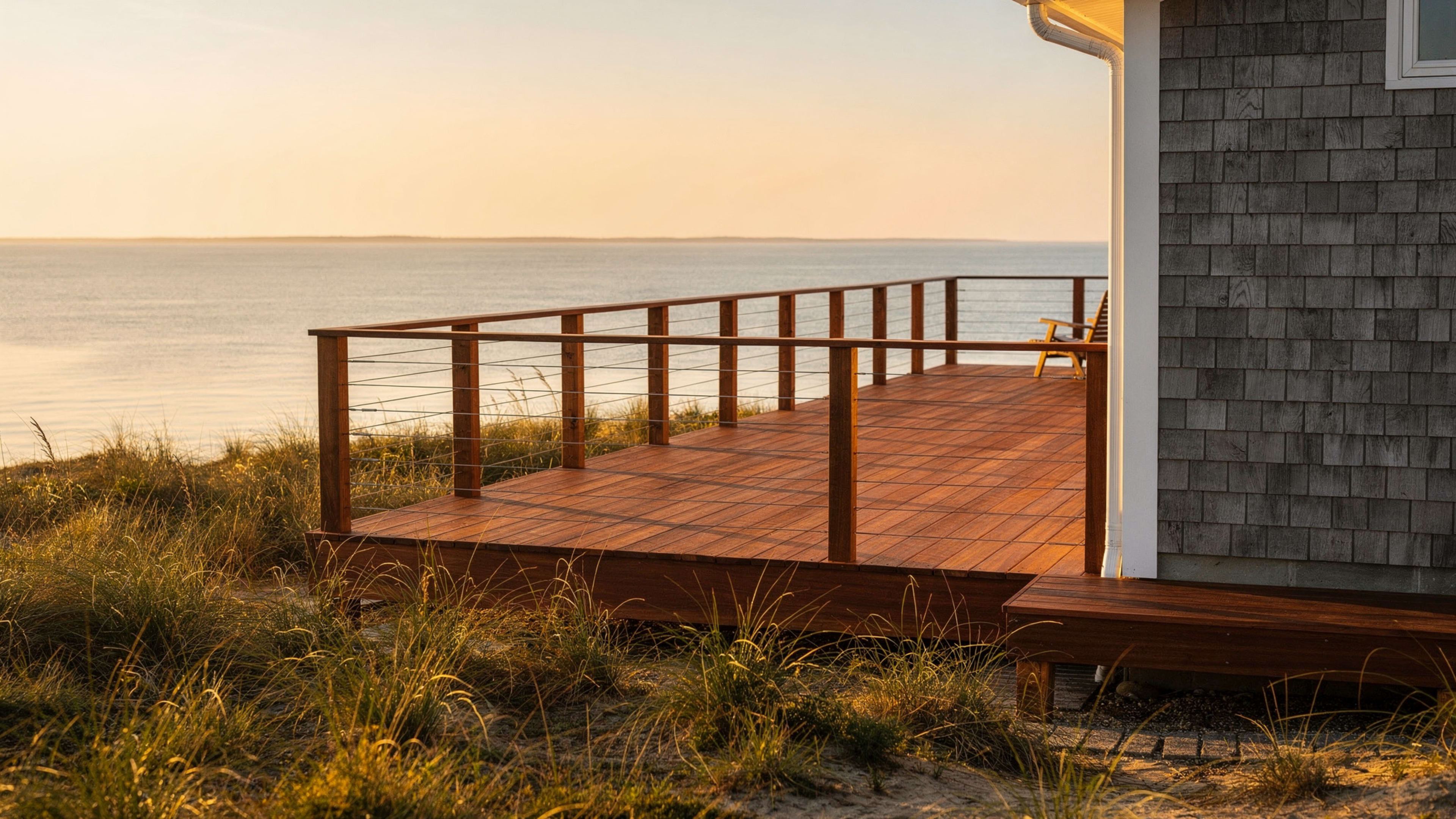
Why Cape Cod Is Hard on Decks
A deck on the Cape lives a harder life than most of its inland cousins. Salt-laden air pits fasteners and dulls finishes. UV bounces off the water and the light-colored sand and cooks the top surface of every board. Damp ocean fog rolls in most nights of the summer, then bakes off in the morning — a wet/dry cycle that stresses the joints between boards and speeds up rot in anything that stays soft. In winter, freeze/thaw cycles work over anything that's already loose or open-grained.
Add in a short building season (frozen ground on the shoulder months, then a slam of second-home owners who want their deck ready before Memorial Day) and the constraints that come with being a peninsula — wetlands, dunes, private wells, and older homes in historic districts — and you have a project that rewards planning far more than it rewards a good deal on materials.
The Material Menu, from Softest to Toughest
Before you argue mahogany vs Trex, it helps to see the whole shelf.
Pressure-treated (PT) pine. The old default. Cheapest per square foot, widely available, easy for any framer to work with. Modern PT is treated with copper azole or MCA — better than the old CCA chemistry, but harder on standard fasteners in salt air (more on that below). PT boards check, cup, and gray quickly if not sealed, and even then need re-sealing every year or two on the Cape.
Western red cedar. Softer, lighter, prettier grain. Beautiful on a shaded deck, but on a south-facing water view it silvers and softens fast. Fine for railings or accent bands; a harder sell for the main walking surface unless you love the maintenance.
Tropical hardwoods (Ipe, Cumaru, Red Balau, Garapa, Machiche, and "genuine mahogany" species). Dense, oily, naturally rot-resistant. This is the "mahogany" most Cape builders mean when they say the word — often Red Balau or a Meranti-family (Shorea) board sold as Philippine or coastal mahogany — names vary by lumberyard, so ask your supplier exactly what species you're getting. Genuine Swietenia mahogany is rare and expensive; most residential decks use a related species. All of them are dramatically harder and denser than PT or cedar, take a rich color under a penetrating oil, and require pre-drilling and stainless fasteners.
Composite (wood-plastic). Trex, TimberTech's composite lines, Fiberon, Deckorators. Modern capped composites — a wood-and-plastic core wrapped in a hard polymer shell — perform very differently from the first-generation uncapped boards that gave the category a bad name in the early 2000s. Fade and stain warranties on premium lines are typically long — Trex, for example, currently warrants its Transcend line for 50 years residential with 25 years of fade coverage (verify current terms with the manufacturer). Best-in-class boards handle salt air well.
PVC (all-plastic, "cellular PVC"). TimberTech's AZEK-branded Advanced PVC, Fiberon Paramount, and other brands. No wood in the board at all. Lightest of the synthetics, coolest under bare feet in some product lines, and the most dimensionally stable against moisture. Priced at or above tropical hardwoods.
Aluminum. A niche choice for oceanfront and elevated decks where drainage below matters. Powder-coated, essentially indestructible, but a different aesthetic and a specialized installer pool.
Mahogany, Up Close
On the Cape, "mahogany" usually means a dense tropical hardwood milled to a 5/4 deck profile. Homeowners love it for the reasons you'd expect: warm color, tight grain, a real-wood feel under bare feet, and the way an oiled deck looks against gray shingles.
What you're signing up for:
- Annual oiling. A penetrating oil finish (Penofin, Messmer's, Ipe Oil, etc.) needs to go on once a year — sometimes twice on a fully exposed south-facing deck — to keep the color. Skip it and the boards will silver out. That's a choice, not a failure, but it's yours to make on purpose.
- Movement. These boards move with humidity. Good installers hidden-fasten them with clips designed for hardwood, leave the right gaps, and don't fight the wood.
- Sourcing. Ask where the wood is from and whether it's FSC-certified. Legit suppliers can show you the chain of custody. It matters both ethically and for the quality of the board you get.
- Cost. Materially more expensive than PT, generally comparable to premium composite or PVC. Get current per-square-foot numbers from at least two suppliers before you budget.
Composite and PVC, Up Close
Modern capped composite and PVC solve the problem most Cape homeowners actually want solved: I don't want to be on my knees with a sander every June. They don't need to be stained, they resist salt and mildew, and they hold their color for many years (check the exact warranty language for your product — coverage is conditioned on following the manufacturer's installation instructions, and general exclusions for storms and environmental conditions apply).
Trade-offs worth knowing:
- Heat. Dark boards in full sun on a July afternoon get hot. Light and mid-tone boards are much more forgiving. If you go dark, plan for shade.
- Look. The realistic multi-tone products (TimberTech Advanced PVC, Trex Transcend Lineage, Fiberon Paramount, Deckorators Voyage) look very good; the entry-level lines look like what they are. If you're leaning composite, spend the money on a mid or premium line.
- Framing life. A 25-year deck board on a 15-year frame is a bad trade. See below.
The Frame Is the Deck
Any Cape Cod deck builder worth hiring will spend more time talking about framing than surface boards. In salt air, the invisible parts of the deck are usually what fails first.
Look for:
- Ground-contact-rated PT for anything close to grade, not standard above-ground PT.
- Stainless steel (316 for oceanfront, 304 acceptable further inland) or hot-dip galvanized fasteners. Modern PT chemistry will eat electro-galvanized screws in a coastal environment. Regular bulk deck screws from the box store are a red flag.
- Joist tape or a peel-and-stick membrane across the tops of every joist and beam. Cheap insurance against the water that always finds its way between the boards.
- Ledger flashing done correctly, with a proper drip edge — not a bead of caulk protecting your house wall.
- Post bases off concrete, not buried in it. A wet post that can't dry is a countdown timer.
- Consider a steel or aluminum sub-frame (Fortress Evolution, Trex Elevations) if you're on a premium surface material and want the framing to outlive the boards.
Permits, Wetlands, and Historic Districts
Most Cape towns require a building permit for a new deck or a substantial rebuild. Beyond that, three things trip up more Cape projects than anything else:
- Conservation Commission jurisdiction. If any part of your lot is within the buffer zone of a wetland, salt marsh, coastal bank, or vegetated dune, your local ConsCom likely has a say. Confirm exact buffer distances and filing requirements with your town's Conservation office before you finalize a design.
- Historic District Commission review. Provincetown and Chatham (its Historic Business District), along with the Old King's Highway Regional Historic District covering portions of Sandwich, Barnstable, Yarmouth, Dennis, Brewster, and Orleans, have designated historic districts where exterior changes — railings, stairs, sometimes even material choices — need HDC approval. Confirm with your town whether your address falls in a district.
- Title 5 septic setbacks. A deck built over or too close to a septic tank or leach field can conflict with Title 5 and local Board of Health setback and access rules, and your town may check the deck location against your septic plan during permitting. Have your builder pull the septic plan before locking the footprint.
FEMA flood-zone (V or A zone) properties can carry additional floodplain requirements for decks and elevated structures. If your lot is in a mapped flood zone, have your builder confirm the design with your town's building department or floodplain administrator before you finalize it.
Rough Cost Framing (Verify Locally)
We don't publish specific dollar figures we haven't sourced this week — Cape material and labor pricing moves too fast, and second-home owners get burned by stale numbers. Use these relationships to sanity-check your quotes:
- Pressure-treated is the cheapest per square foot.
- Cedar tends to land near PT for materials but higher for labor (softer wood, more finishing).
- Mid-grade capped composite generally runs meaningfully more than PT.
- Premium composite, PVC, and tropical hardwoods cluster at the top and are often within striking distance of each other.
- On any material, expect railings, stairs, and built-in benches to add a large percentage on top of the deck-surface number.
Get three itemized quotes on the same scope — same framing spec, same fasteners, same railing system — before you compare prices.
Questions to Ask Any Cape Deck Builder
- Are you licensed as a Massachusetts Construction Supervisor and registered as a Home Improvement Contractor? (Verify both on the state's public lookup.)
- Do you carry general liability and workers' comp? Can I see current certificates?
- What fastener grade do you use in salt air, and why?
- Do you flash the ledger and tape the joists as standard, or as an upgrade?
- Who pulls the permit — and does the scope include ConsCom or HDC filings if my lot needs them?
- How do you handle warranty callbacks if I'm off-Cape most of the year?
- Can I see two decks you built here at least five years ago?
Red Flags
- "We don't need a permit for this."
- Cash-only discount with no written contract.
- No mention of joist tape, flashing, or fastener grade.
- Quotes that don't itemize surface material, framing, railings, and stairs separately.
- Vague warranty ("we stand behind our work") with nothing in writing.
- Pressure to sign the same day, or to pay more than a modest deposit up front (Massachusetts law caps HIC deposits at the greater of one-third of the contract price or the actual cost of special-order materials).
How to Vet a Pro on Cape Cod
Beyond the license check, ask for local references you can actually drive by. A builder who has been working the Cape for a decade will have a portfolio you can see from the street. Read reviews with an eye for how they handled problems, not just the compliments. And if you're a second-home owner, make sure your builder has a system for communicating and sending progress photos to owners who aren't on-Cape — the best Cape contractors do this as a matter of course.