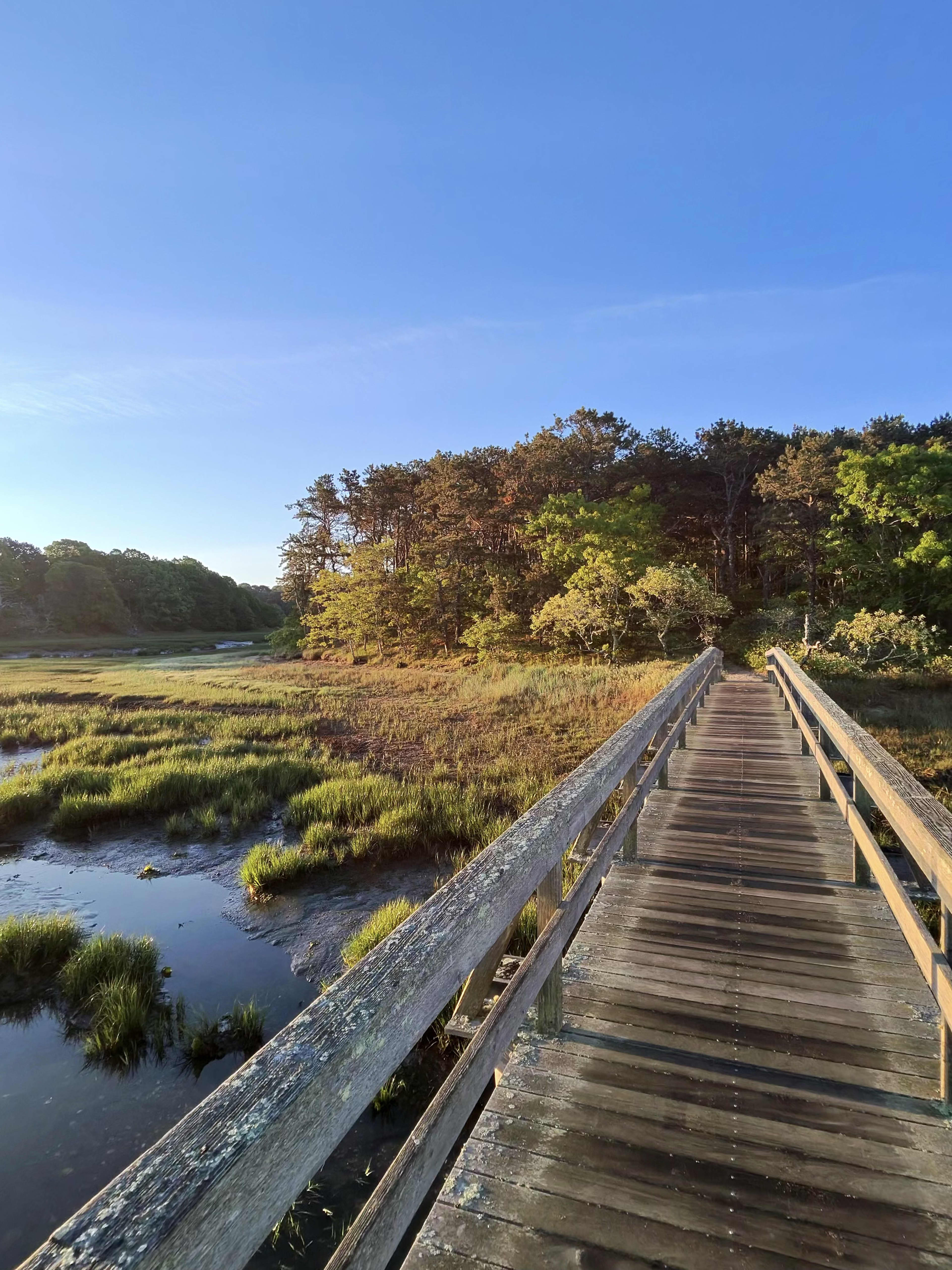
Cape Cod lawns play a different game
If your lawn strategy was borrowed from a friend in Metrowest or a magazine written for the Midwest, you have already lost half the season. Cape Cod turf lives on glacial outwash sand, drinks from a sole-source aquifer, and takes salt on the wind for months at a time. What holds a lawn together in Framingham will burn out here by the Fourth of July.
This guide is written for two kinds of readers: full-time homeowners who want a lawn that actually looks like a lawn in August, and second-home owners who want the property to be renter-ready without being on-Cape every weekend. It doubles as a working reference for the landscape crews we send out — because the fundamentals do not change whether you are in Chatham, Sandwich, or Provincetown.
The three constraints that shape everything
1. Sandy, low-organic soil. Most Cape lots drain fast, hold almost no nutrients, and swing acidic. Water and fertilizer move through the root zone in hours, not days. That means smaller, more frequent inputs beat the traditional "four heavy feedings" calendar every time.
2. Salt air and salt spray. Anything within a few hundred yards of open water — Nantucket Sound, Cape Cod Bay, the backside beaches — is dealing with airborne salt. Kentucky bluegrass hates it. Fine and tall fescues tolerate it well. Perennial ryegrass is in the middle. If your lawn browns on the ocean-facing side every August and you keep re-seeding with the same big-box mix, the mix is the problem.
3. Water rules and nitrogen rules. Cape Cod sits over a sole-source aquifer, and nitrogen loading into estuaries is a regional issue the Cape Cod Commission and MassDEP have been working on for years. Many towns have adopted summer irrigation schedules (odd/even days, no-daytime-watering windows), and some watershed areas have local fertilizer bylaws that go beyond the state rule. Confirm current irrigation days, hours, and fertilizer restrictions with your town DPW or water department before the season starts — the specifics vary town to town and can change year to year.
A realistic Cape Cod lawn calendar
Late winter (February–March)
Walk the property on the first dry day. Look for vole runs under matted grass, plow damage at the edge of the driveway, and salt burn along road frontage where the town sanded heavily. Rake out the worst of it so the crown of the grass can dry and breathe. Do not fertilize frozen or saturated ground — it is money washing straight to the bay.
This is also the right window to book spring cleanups and aeration for April/May. Every reputable Cape crew is fully booked by early April; the homeowners who call in June end up on a waitlist or with whoever is left.
Early spring (April)
Soil test. A basic test through UMass Extension is inexpensive and tells you three things that matter here: pH (Cape soils usually want lime), organic matter (usually low, worth topdressing with compost), and phosphorus. Massachusetts restricts phosphorus in lawn fertilizer under state law — verify the current rule before applying any starter fertilizer, especially on established lawns.
Apply lime if the test calls for it. Pre-emergent crabgrass control goes down when the forsythia is in full bloom — that is a better trigger on the Cape than a calendar date, because our spring runs one to three weeks behind the mainland depending on where you are on the peninsula.
Late spring (May–early June)
First real feeding, and keep it light. A slow-release nitrogen source at a modest rate does more for sandy soil than a heavy synthetic dump that leaches past the roots in the next rain. Mow tall — 3.5 to 4 inches — from the very first cut. Tall grass shades the soil, holds moisture, and out-competes crabgrass and poa annua without chemicals.
Get the irrigation system audited before Memorial Day. Broken heads, misted zones, and controllers still running on last year's schedule waste more water than any lawn on the Cape actually needs. Ask your irrigation tech about smart controllers — some Massachusetts water suppliers and the state have historically offered rebates on WaterSense-labeled smart controllers; confirm current rebate availability with your local water department and Mass Save before purchasing.
Summer (late June–August)
This is survival mode, not growth mode. Cool-season grasses (which is everything that grows here) naturally slow down in July heat. Fighting that with more water and more nitrogen produces disease, not a greener lawn.
Rules of thumb that actually work on Cape sand:
- Water deep and infrequent. Two longer sessions per week beat daily light watering, which trains roots to stay shallow.
- Water before dawn, never in the evening. Overnight wet blades are how you get dollar spot and brown patch.
- Raise the mower another notch. Four inches is not too tall in July.
- Sharpen the blade monthly. Torn grass tips brown out and look drought-stressed even when they are not.
- Skip midsummer fertilizer unless you are on a specific program with a pro. On sandy soil, summer nitrogen mostly feeds fungus and the aquifer.
If your town declares a water restriction — and several Cape towns issue advisories or mandatory restrictions in dry summers — comply immediately. The fines are one thing; the reputational hit of a green lawn during a public restriction is worse, especially on a rental property.
Early fall (September–October) — the most important six weeks of the year
If you only do one thing right on a Cape Cod lawn, do fall renovation. Cool nights, warm soil, and reliable rain make September and October the actual growing season for cool-season turf here.
The sequence for a tired lawn:
- Core aerate — pull real plugs, not spike-aerate. Sandy soil compacts less than clay, but thatch and matted roots still choke oxygen and water movement.
- Overseed with a Cape-appropriate blend. For sun with salt exposure, lean on tall fescue and fine fescue. For shade under scrub oak and pine, fine fescue dominates. Straight Kentucky bluegrass is the wrong answer for most Cape properties.
- Topdress with a quarter-inch of compost. Over three or four seasons this is what actually builds organic matter into sand and finally gives you a lawn that holds water for more than a day.
- Starter fertilizer at label rate, respecting state phosphorus rules noted above.
- Water lightly, twice a day, for two to three weeks until germination is established, then taper back to deep-and-infrequent.
Late fall (November)
One last feeding — a true winterizer with slow-release nitrogen — after the final mow but before the ground freezes. This is the feeding that determines how your lawn wakes up next April. Clean leaves off the turf; a heavy mat of oak leaves left through a wet winter will kill grass by March.
Storm prep is lawn prep
Nor'easters and the occasional tropical remnant do more damage to Cape lawns than most homeowners credit. Standing salt water from a storm surge is a lawn killer — if a section of your yard floods with seawater, flush it heavily with fresh water as soon as it is safe, then plan on gypsum and aggressive overseeding in the fall. Wind-driven salt spray from a big blow can brown out an entire ocean-facing lawn overnight; a good rinse with fresh water within 24 hours limits the damage.
The off-season booking advantage
Here is the piece nobody in the industry says out loud: the homeowners who get the best crews, the best pricing, and the best schedule slots are the ones who book their season in January and February, not April. By mid-spring, every established Cape landscape and irrigation company is triaging. If you are a second-home owner coordinating from Boston, New York, or further, locking in your season before the daffodils are up is worth real money and real peace of mind — especially if the property is on a summer rental calendar where a brown lawn in July is a review problem.
What to ask any lawn care pro before you sign
- Are you licensed by the Massachusetts Department of Agricultural Resources for pesticide application, if that is part of the program?
- What is your fertilizer program by month, and how does it respect the state phosphorus rule and any local nitrogen bylaw?
- Do you soil test before recommending amendments?
- What seed blend do you use for overseeding on this side of the Cape, and why?
- What is your policy during a town water restriction?
If the answers are vague, keep calling.
A good Cape Cod lawn is not a fight against the Cape — it is a lawn built for the Cape. Sand, salt, and a short growing window are the assignment, not the enemy.
More Cape Cod home guides
- Hiring a Landscaping Contractor in Wareham, MA
- Hiring a Landscaping Contractor in Truro, MA
- Hiring a Landscaping Contractor in Yarmouth, MA
- Native Plant Landscaping on Cape Cod: What to Plant, What to Remove & What the Conservation Commission Cares About
- Cape Cod Landscaping This Summer: Water Bans, Nitrogen Rules, Tick Season & Why You Should Book Fall Now
- Hiring a Landscaper on Cape Cod: A Homeowner's Guide to Lawns, Beds, and the Stuff Off-Cape Pros Miss
- Radon Testing & Mitigation on Cape Cod: What the Science Says and What to Do
Get the best of Cape Cod — free.
Guides, hidden spots, and seasonal tips from people who actually live here.