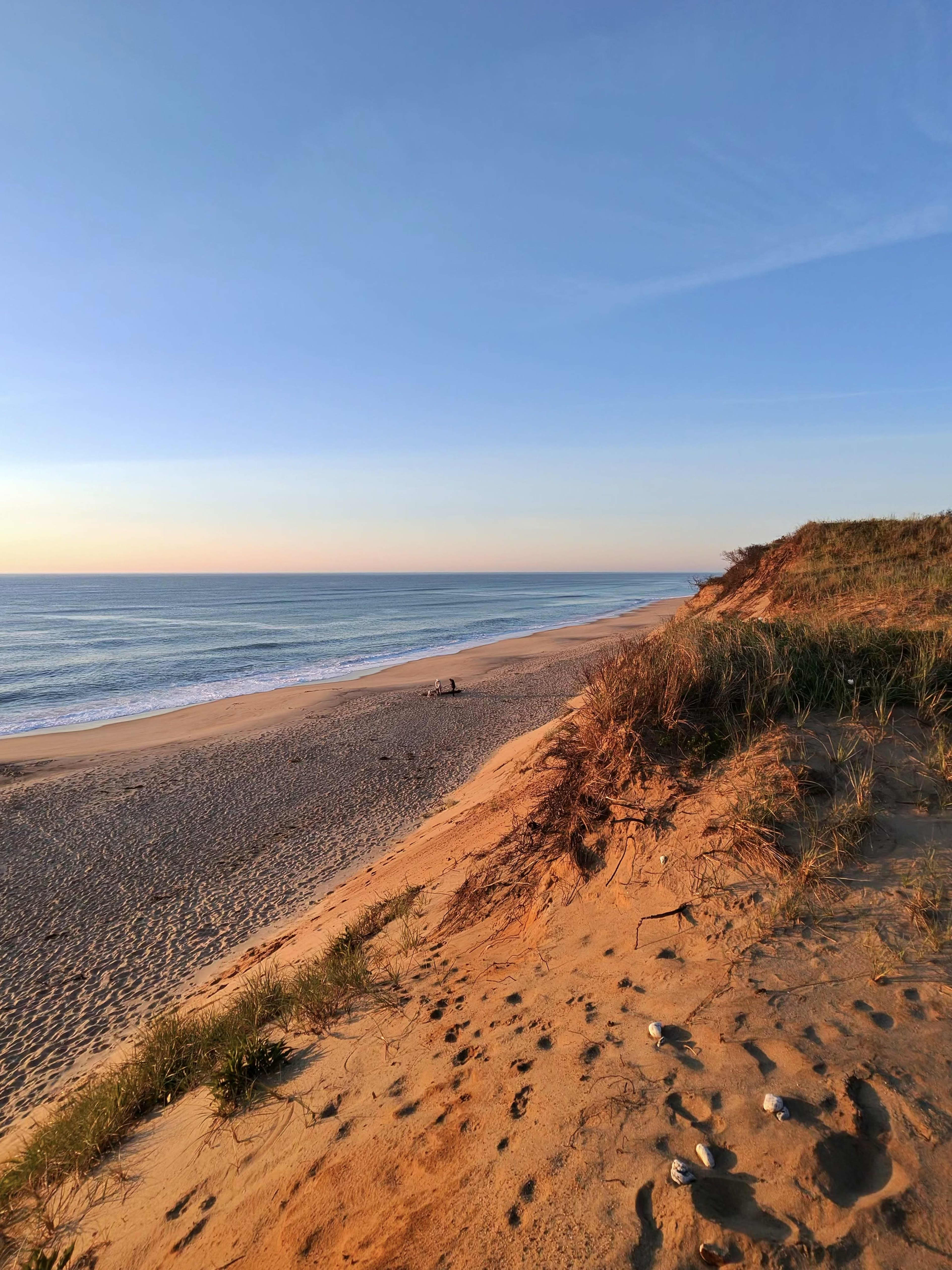
On a clear summer night, stand at the edge of Marconi Beach in Wellfleet and look straight up. The Milky Way arches overhead in a dense, unbroken band — thousands of individual stars visible to the naked eye, the core of our galaxy blazing in the south. This is stargazing Cape Cod, and once you experience it, it changes how you think about the night sky.
The Outer Cape is one of the most accessible dark-sky destinations in southern New England, and it earns that reputation honestly. Three sides of water surround the peninsula — the Atlantic Ocean to the east, Cape Cod Bay to the west, and the open ocean off Provincetown to the north — which means light pollution from inland Massachusetts simply cannot reach you the way it reaches inland towns. Add 44,600 acres of protected Cape Cod National Seashore land that keeps commercial development away from the shoreline, and you have a genuinely rare combination: darkness, accessibility, and stunning scenery all in one place.
Why the Outer Cape Is So Dark
Light pollution requires density — shopping centers, parking lots, subdivisions, highways. The Outer Cape towns of Truro, Wellfleet, Eastham, and Provincetown have some of the lowest year-round population densities in Massachusetts. From Eastham's Salt Pond Visitor Center northward, Route 6 runs through an almost unbroken corridor of National Seashore land. There are no big-box stores, no highway interchanges lined with gas stations, no sprawling residential grids generating the orange sodium-vapor glow that blankets suburban Boston.
The result, measured in Bortle scale terms (the standard astronomer's measure of night sky brightness), is that the Outer Cape regularly achieves Bortle Class 4 or lower on new moon nights away from town centers — dark enough to see the Milky Way clearly, dark enough to make out the Andromeda Galaxy with the naked eye, dark enough for serious astrophotography.
The Best Stargazing Spots on Cape Cod
Marconi Beach, Wellfleet
Marconi Beach is arguably the single best drive-to stargazing location on Cape Cod. The parking area sits on a bluff above the Atlantic Ocean, facing due east, with no artificial light between you and the horizon. On a clear night, the sky above the ocean is perfectly black at the waterline. The Milky Way core rises in the south, and the open eastern horizon means you can watch stars and planets rise cleanly above the water.
Named for Guglielmo Marconi, who transmitted the first transatlantic wireless message from this bluff in 1903, the site already carries a certain weight of history. At night it becomes something else entirely. Arrive by 9:30 p.m. in midsummer and you will have the parking area largely to yourself. Bring a blanket — the bluff catches every breath of wind off the Atlantic — and give your eyes a full 20 minutes to dark-adapt before you judge the sky.
Highland Light Area, Truro
The area around Highland Light in Truro offers open fields, minimal local development, and sweeping 360-degree visibility. The lighthouse itself is the oldest on Cape Cod, first lit in 1797, and the surrounding Highland Links Golf Course — the oldest golf course on Cape Cod — creates a wide buffer of open, unlit land. Stand in the fields north or south of the light and you have unobstructed horizon lines in nearly every direction.
Truro's year-round population is among the smallest of any incorporated town in Massachusetts, which means almost no ambient light from residential neighborhoods. The Atlantic lies a short walk east; Cape Cod Bay is visible to the west. On a new moon night in August, this is one of the premier stargazing locations in New England.
Fort Hill, Eastham
Fort Hill in Eastham is the Outer Cape's best inland stargazing site. The elevated drumlin provides genuine 360-degree views — across the Nauset Marsh to the Atlantic in the east, across open meadows to the west, with the lights of Route 6 too distant to cause significant light pollution. The National Seashore maintains the area as open meadow, and the parking area is spacious enough to spread out.
Fort Hill also benefits from being surrounded on multiple sides by water and marsh, which keeps the local horizon free of interference. In midsummer, the Milky Way core hangs above the southern meadows while satellites trace slow arcs from horizon to horizon.
Cahoon Hollow Beach Access, Wellfleet
Cahoon Hollow Beach is one of Wellfleet's Atlantic-facing outer beaches, and the access road and parking area sit on the outwash plain above the dune face. Like Marconi Beach, it faces open ocean. The walk down to the beach itself is short, and once you are on the sand, the dunes block any residual light from the access road behind you. Lie on the beach and the entire sky above is yours — east, south, north, west. This is an excellent spot for watching the Perseid meteor shower, when meteors radiate from the northeast and streak across the full dome of sky.
Nickerson State Park, Brewster
Nickerson State Park in Brewster offers a different character than the ocean beaches. The park's 1,900 acres of inland forest, kettle ponds, and campground loops are well away from Route 6 and surrounded by trees that block light from all directions. For campers spending nights in the park, the sky above the open ponds — Cliff Pond, Flax Pond, Little Cliff Pond — is excellent. The water surface also provides natural reflection, making for memorable astrophotography. Brewster sits on the Bay side of the Cape, so light from the Boston metro area on the western horizon can occasionally be visible on very clear nights, but overhead the sky is genuinely dark.
What to See and When: A Month-by-Month Guide
June through September: The Milky Way Core
The core of the Milky Way — the bright, dense central bulge of our galaxy — is visible from the Outer Cape on clear, moonless nights from June through September. It rises in the southeast around 9:30–10:00 p.m. in June, earlier as summer progresses. By August it transits high in the south around midnight. This is the prime window for stargazing Cape Cod style: warm nights, short sleeves possible, long clear horizons.
August 11–13: The Perseid Meteor Shower
The Perseids are the most reliable and widely observed meteor shower of the year. The shower peaks every year around August 11–13, when Earth passes through the debris trail left by Comet Swift-Tuttle. At peak, observers under dark skies can see 80–100 meteors per hour. Cape Cod's Atlantic beaches are ideal viewing locations because the Perseid radiant — the point in the constellation Perseus from which meteors appear to originate — rises in the northeast, directly over the open ocean for east-facing beaches like Marconi and Cahoon Hollow. Meteors radiate outward from Perseus across the full sky, so you do not need to look directly at the radiant. Simply lie on your back and watch.
Check the moon phase for the peak nights. In years when the Perseids coincide with a new moon, the show is exceptional. Even in years with a partial moon, the brightest Perseids (fireballs that leave glowing trains in the sky for several seconds) will punch through the lunar glow.
Fall and Winter: Orion and the Planets
As summer ends and the Milky Way core sets with the season, Orion rises in the east on autumn evenings and dominates the winter sky. The constellation's signature three-star belt, the nebula visible below it even to the naked eye under dark skies, and the contrast between the red supergiant Betelgeuse (upper left) and the blue-white Rigel (lower right) make Orion one of the most dramatic sights in the winter sky from Cape Cod beaches.
Jupiter and Saturn are often prominent in the summer and fall sky and are visible even from areas with moderate light pollution. Through binoculars, Jupiter's four Galilean moons — first observed by Galileo in 1610 — are visible as bright pinpoints flanking the planet.
Moon Phases and Planning Your Night
A full moon is beautiful but it washes out faint stars and the Milky Way entirely. Plan your best stargazing nights around the new moon, when the moon rises and sets with the sun and the sky is dark all night. The window of five to six nights on either side of new moon — when the crescent is thin and sets early — also gives excellent dark-sky conditions.
Free apps and websites publish moon phase calendars months in advance. Mark the August new moon each year and the Perseid peak, and you have the single best stargazing night of the calendar year on the Outer Cape circled in your planner.
Gear and Preparation
Red flashlight only. White light destroys your dark adaptation (the process by which your eyes open their pupils and activate rod cells over roughly 20 minutes). A red flashlight lets you navigate safely without resetting your night vision. Red-light headlamps designed for astronomy are inexpensive and widely available.
Layers. Even in August, temperatures on the Atlantic-facing beaches can drop 15–20 degrees after midnight as onshore winds pick up. Bring a jacket and a blanket regardless of how warm the evening felt at dinner.
Binoculars. A standard pair of 7×50 or 10×50 binoculars transforms a stargazing session. The Andromeda Galaxy becomes unmistakable, the Pleiades cluster resolves into dozens of individual stars, and Jupiter's moons snap into focus. You do not need a telescope.
A star chart or app. SkySafari, Stellarium, and similar apps let you point your phone at the sky and identify what you are seeing. Enable the app's night mode (red screen) before you go out.
Cape Cod National Seashore Night Sky Programs
The Cape Cod National Seashore offers ranger-led night sky programs during the summer season. These typically take place at the Salt Pond Visitor Center in Eastham and at select beach locations, and they combine constellation identification with natural history interpretation. The Seashore has been part of ongoing discussions about International Dark Sky Place designation, which would formally recognize and protect the dark skies above the National Seashore land. Check the Seashore's official program calendar each summer for dates and registration details, as programs book quickly.
Astrophotography on Cape Cod Beaches
The combination of dark skies, open Atlantic horizons, and dramatic foregrounds — lighthouse silhouettes, dune grasses, historic wreck markers — makes the Outer Cape a destination for astrophotographers. Marconi Beach is the most popular location because the bluff provides elevation, the horizon is clean, and the parking area is accessible late at night. A sturdy tripod, a wide-angle lens, and exposures of 15–25 seconds at ISO 1600–3200 will capture the Milky Way above the Atlantic in summer. Bring a remote shutter release to avoid camera shake, and check the tide chart — shooting from the water's edge at low tide gives you the star reflection in wet sand, one of the most striking compositions available anywhere in New England.
Beaches & trails in this guide
Put This Guide to Work
Get the best of Cape Cod — free.
Guides, hidden spots, and seasonal tips from people who actually live here.
Frequently asked questions
Where are the best spots to see stars on Cape Cod?
The Outer Cape, including Wellfleet, Truro and Eastham, offers the darkest skies, because large stretches of National Seashore land limit light pollution. Marconi Beach in Wellfleet and Fort Hill in Eastham are popular spots, with open ocean horizons and wide views of the sky.
What moon phase is best for stargazing, and how do I plan around it?
A full moon washes out the Milky Way entirely, so plan around the new moon when the sky stays dark all night. The five or six nights on either side of new moon — when the crescent is thin and sets early — also give excellent conditions. Moon phase calendars are available months in advance to help you plan ahead.
Why do stargazers use a red flashlight instead of a regular one?
White light destroys your dark adaptation — the process by which your eyes gradually adjust to darkness and become sensitive enough to see faint stars. A red flashlight lets you navigate safely without resetting your night vision. Red-light headlamps designed for astronomy are widely available.
When is the Perseid meteor shower, and is Cape Cod a good place to watch it?
The Perseids peak every year in mid-August, and the Cape's dark Atlantic beaches make good viewing spots. Meteors cross the whole sky, so lie back and watch. Check the moon phase: a dark, moonless night near the peak gives the best show.
Does Cape Cod National Seashore offer any organized stargazing events?
The Seashore offers ranger-led night sky programs during the summer season, typically at the Salt Pond Visitor Center in Eastham and at select beach locations, combining constellation identification with natural history interpretation. Programs book quickly, so check the Seashore's official program calendar each summer for dates and registration details.