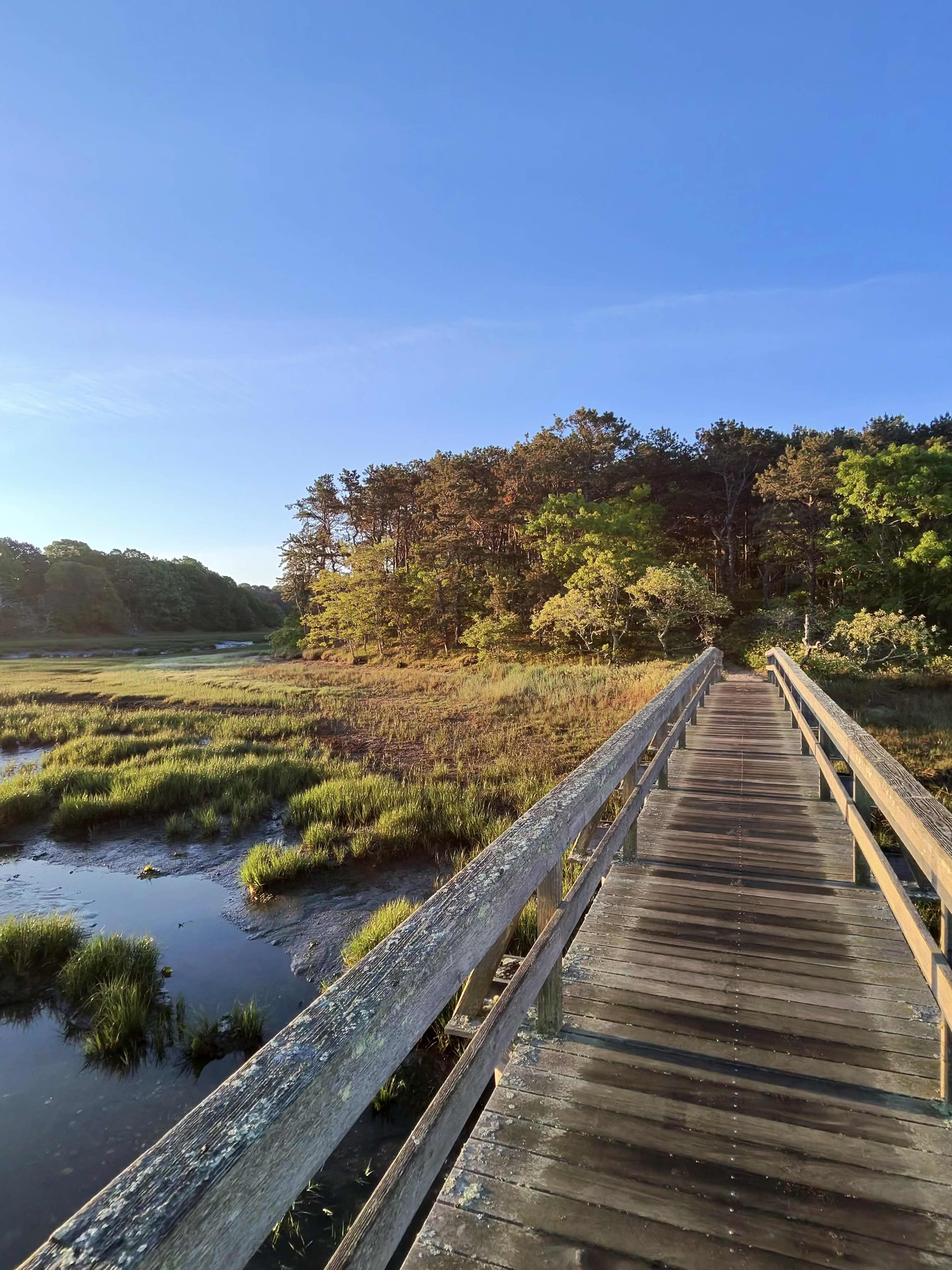
Why Cape Cod Is Harder on Decks Than Anywhere Else in New England
Before you pick a decking material, you need to understand what you're actually up against. Cape Cod is not just another coastal environment — it's a compounding set of stressors that will expose every weakness in an underspecified deck within three to five years.
UV exposure is extreme. Cape Cod averages 4.7+ peak sun hours per day during the summer months — among the highest readings in New England. That intensity bleaches surface finishes, degrades the lignin that holds wood cells together, and accelerates color fade in composite materials that aren't properly UV-stabilized. A deck that holds up fine in Worcester will look ten years older after one summer in Chatham or Wellfleet.
Salt air doesn't stop at the surface. The aerosol moisture off Nantucket Sound and Cape Cod Bay carries dissolved chlorides that penetrate finish coats, corrode fasteners, and oxidize exposed metal hardware. Homeowners in Brewster and Eastham often discover their deck screws have bled rust stains across the boards long before the decking itself fails. The hardware matters as much as the surface.
Freeze-thaw cycles are relentless. Cape Cod's climate is milder than interior Massachusetts, but it still delivers enough sub-freezing nights to drive moisture expansion and contraction through every deck material repeatedly each winter. Wood checks and splinters. Composite boards can cup if improperly installed. Fasteners loosen. Every material needs to be installed with appropriate gapping and expansion allowance to survive this.
Second-home owners face a compounding problem. If your Falmouth or Orleans property sits unoccupied from October through May, no one is clearing standing water, sweeping mold-friendly debris, or catching the early signs of rot or delamination. Eight months of neglect followed by heavy summer use is the formula for a deck that fails in year six instead of year twenty. Material choice is your insurance policy when maintenance is intermittent.
How to Evaluate Any Deck Material Before You Buy
Every contractor will pitch you something different. Use these criteria to evaluate any material on its own merits.
- Moisture absorption rate. Lower is better. High moisture absorption leads to dimensional instability — boards swell, gap, cup, and eventually rot. For a Cape Cod oceanside installation, you want a material that absorbs as close to zero water as possible.
- UV resistance and fade rating. Look for a published fade and stain warranty, not just a general warranty. Premium composite brands publish Delta E color-change limits. If a manufacturer won't commit to a number, assume the color won't hold.
- Scratch resistance. High foot traffic on gritty, sandy feet — a daily reality at any Cape Cod home — will surface-scratch soft materials quickly. Harder capped composites and PVC products outperform softwoods here significantly.
- Slip resistance when wet. This is non-negotiable for any deck close to the water. Smooth-profile boards that look beautiful when dry can become dangerous after rain or spray. Ask for wet-surface COF (coefficient of friction) data, or stick to grooved or textured profiles.
- Fastener corrosion resistance. More on this below, but no material performs well when paired with the wrong fastener.
- Warranty length and exclusions. A 25-year warranty that excludes "coastal environments" or requires annual professional cleaning is worth far less than it appears. Read the fine print before specifying any product for a waterfront installation in Sandwich or Wellfleet.
- Installed cost per square foot. Material cost alone is misleading. Labor, fasteners, hidden clips, and required gap spacing all affect the final number.
The Materials: An Honest Cape Cod-Specific Assessment
Pressure-Treated Lumber — The Structural Foundation, Not the Surface
Pressure-treated southern yellow pine is the standard for deck framing, joists, beams, and posts — and it should stay that way. The code-required Ground Contact or Above Ground PT ratings give you the rot and insect resistance you need in a substructure that's constantly exposed to moisture.
What PT lumber should not be is your walking surface in a salt-air environment. Modern pressure treatments (ACQ, CA, MCA) are corrosive to standard fasteners and hardware. When combined with coastal moisture and chlorides, the galvanic reaction accelerates dramatically. If you're seeing a stained or corroded deck substructure on a Cape Cod home that's only six or eight years old, this is frequently the cause. Use PT for structure — always. Use it as a decking surface only as a last resort, and never without premium-grade coated or stainless fasteners.
Ipe and Tropical Hardwood — The Premium Natural Option
Ipe (Brazilian walnut) is one of the densest commercially available wood species — dense enough that it won't absorb meaningful moisture, naturally resistant to insects and rot, and capable of lasting 40+ years with proper maintenance. Installed costs run $25–$40 per square foot on Cape Cod, and the labor premium is real: ipe requires pre-drilling every single fastener hole to avoid splitting, which adds time.
Without finishing, ipe silvers to a handsome grey that actually suits Cape Cod aesthetics well. With periodic treatment using a penetrating hardwood oil (every 1–2 years), it maintains a rich brown. The sourcing and sustainability picture for tropical hardwoods is genuinely complicated — FSC-certified ipe exists but commands a further premium, and verification of chain of custody is imperfect. This is a material worth discussing with your contractor if you have environmental priorities.
Cedar — The Traditional Cape Cod Choice
Western red cedar is the historic residential decking standard for good reason. It's naturally rot-resistant, light enough to work easily, stable enough to resist significant warping, and it weathers to the silver-grey that feels native to Cape Cod aesthetics. Installed costs typically run $15–$25 per square foot.
The honest caveat: cedar still requires maintenance in Cape Cod conditions. Plan on cleaning and re-staining or sealing every two to three years — not five, not "when it looks bad." Salt air and UV degradation work faster here than the manufacturer's label assumes. Let cedar go without maintenance and you'll see surface checking, raised grain, and eventual splintering. Cedar is excellent for homeowners who genuinely enjoy seasonal deck maintenance; it's a poor fit for second-home owners who can't commit to that schedule.
Composite Decking — The Dominant Choice for Second-Home Owners
Capped composite decking — Trex Transcend, TimberTech Legacy, Fiberon Symmetry, and their competitors — has become the default specification for Cape Cod second-home owners for a straightforward reason: it requires essentially no finish maintenance. The protective polymer cap resists moisture, UV degradation, salt spray, and mold. Clean it a couple of times per season and it holds its color and structural integrity for decades.
The product tiers matter enormously. Uncapped composite (older Trex lines and budget brands) has no protective shell, absorbs moisture readily, and is not appropriate for coastal Cape Cod installation. Capped composite is the specification you want. Premium lines carry 25–30 year fade and stain warranties, many of which are transferable — a meaningful selling point for a second-home owner who may eventually sell.
Installed costs for quality capped composite with hidden fasteners: $30–$55 per square foot. Expect the higher end of that range for Chatham and Barnstable contractors given current labor rates.
PVC Decking — Maximum Coastal Protection
100% PVC products (Azek, KOMA, Versatex) contain zero wood fiber, which means zero pathway for moisture absorption, rot, or mold. For very exposed coastal locations — properties on or near the water in Wellfleet, Eastham, or Orleans — PVC is the most defensively sound choice you can make. It will not rot, will not absorb salt water, and will not delaminate.
The tradeoffs are real. PVC has a slightly hollow feel underfoot that some homeowners find off-putting compared to wood. It gets noticeably hotter than composite under direct summer sun — worth considering for south-facing decks in Falmouth or Barnstable. And it is expensive: $35–$60 per square foot installed. For a dock application or an oceanfront deck that takes direct spray, that premium is often justified.
Aluminum Decking — Commercial Grade, Residential Exception
Aluminum decking is genuinely impervious to salt air, UV, and moisture. It is also primarily a commercial, dock, and industrial application product. The look is utilitarian in a way that doesn't suit most Cape Cod residential homes, and the installed cost is high. Unless you're decking a commercial pier or a property with a genuine dock-style need, aluminum is not the right residential choice.
Fastener Choice: The Detail That Makes or Breaks Everything
The decking surface gets all the attention, but the fasteners determine whether your installation stays beautiful or starts bleeding rust stains within two seasons.
Use 316 stainless steel in any marine or coastal environment. 304 stainless is common and works adequately inland; on Cape Cod, 316 is the minimum specification. The additional molybdenum content in 316 grade provides meaningful additional resistance to chloride corrosion — the specific failure mode salt air produces.
Hot-dipped galvanized fasteners are an acceptable alternative for framing connections and locations that won't stain visible surfaces. Do not use electro-galvanized (bright zinc) or standard steel screws anywhere on a Cape Cod deck — they will rust through and bleed orange staining marks across your new boards within one to two seasons.
Hidden fastener systems (Trex Hideaway, TimberTech AZEK Hidden Fasteners, Camo clips) eliminate surface fastener exposure entirely and produce a cleaner finished appearance. They add cost but are worth specifying on any premium installation.
The Bottom Line: Which Material for Which Situation
| Situation | Recommended Material |
|---|---|
| Moderate exposure, second-home owner | Capped composite (TimberTech, Trex Transcend) |
| Maximum coastal exposure / oceanfront | PVC (Azek) |
| Owner present, willing to maintain | Cedar or Ipe |
| Substructure (always) | Pressure-treated lumber |
| Budget priority, owner-occupied | Cedar with strict maintenance plan |
More Cape Cod home guides
- Hiring a Outdoor Living & Decks Contractor in Provincetown, MA
- Hiring a Outdoor Living & Decks Contractor in Chatham, MA
- Hiring a Outdoor Living & Decks Contractor in Falmouth, MA
- Adding Shade to Your Cape Cod Deck: Pergolas, Awnings & Shade Sails — Costs, Permits & What Works
- Deck Railings on Cape Cod: Cable, Glass, Aluminum & Wood — What to Choose and What Code Requires
- Cape Cod Decks: Mahogany vs Trex and Everything In Between
- Budget-Friendly Home Improvements: Get More for Less on Cape Cod
FAQ
Does the Town of Barnstable or Chatham require a permit for a new deck? Yes. Any new deck attached to a structure, or any deck over 30 inches above grade, requires a building permit in all Cape Cod towns. Setback requirements, lot coverage limits, and zoning overlay districts (especially in coastal areas) vary by town and lot. Your contractor should pull the permit — if they suggest skipping it, that's a red flag.
How long should a composite deck last on Cape Cod? Premium capped composite from major manufacturers (Trex Transcend, TimberTech Legacy) carries 25–30 year warranties on fading and staining. Realistically, a properly installed capped composite deck in Brewster or Orleans should reach 25+ years with only routine cleaning.
Will composite decking get too hot to walk on barefoot? Composite decking does absorb and retain more heat than wood in direct sun. South-facing decks in Falmouth or Barnstable get the most exposure. Light-colored boards and grooved profiles help; PVC products tend to run hotter than capped composite. If barefoot comfort is a priority, discuss color selection and board profiles with your contractor.
What's the biggest mistake homeowners make when replacing a Cape Cod deck? Keeping the old substructure. A new composite surface on a rotted or under-specified PT frame is a wasted investment. Have your contractor evaluate every joist, beam, and ledger connection before the new boards go down — and use the correct fastener grade for a coastal environment throughout.
Can I use pressure-treated decking boards instead of composite to save money? You can, but it's a short-term savings with long-term cost. PT lumber as a surface material near salt water requires more frequent staining, is more susceptible to checking and splintering, and reacts with non-compatible fasteners. For a second home where maintenance is infrequent, it's a poor trade.
Ready to get it right the first time? Find a Certified deck contractor on the Cape — verified local professionals who understand what actually works in Cape Cod conditions.
Get the best of Cape Cod — free.
Guides, hidden spots, and seasonal tips from people who actually live here.